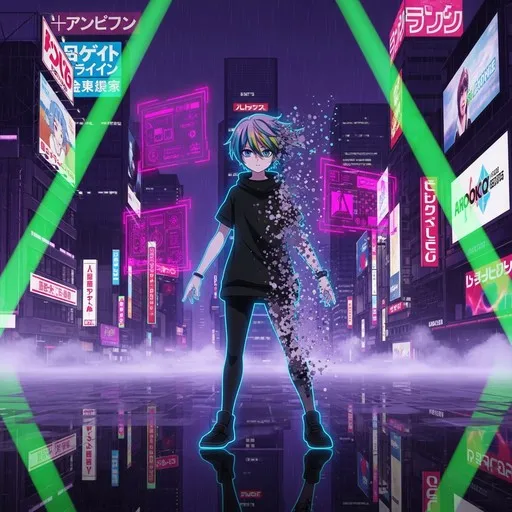
Your Feed Is a Delusion Trigger: Reopening the Chaos;Head Case File

Photo: Microbiz Mag, CC BY 2.0, via Wikimedia Commons
Let's get the confession out of the way first: yes, the Chaos;Head anime is bad. Legendarily bad. 'Nice boat' bad — well, that was School Days, but you get the emotional neighborhood. The 2008 adaptation compressed a dense, deliberately uncomfortable visual novel into twelve episodes of confusion, and Western fandom did what Western fandom does: it turned the whole property into a punchline.
Which is a shame, because underneath the botched adaptation sits a Nitroplus script that reads less like mid-2000s otaku fiction and more like a field manual for the exact digital hellscape we're all currently marinating in. Takumi Nishijou, the game's unwashed, energy-drink-guzzling recluse, isn't just a protagonist. He's a prophecy.
The Boy Who Refused the Timeline
Quick refresher for the uninitiated. Chaos;Head drops you into Shibuya circa the late 2000s, where a string of gruesome murders called the 'New Generation' killings is dominating the news. Our hero Takumi is a shut-in so committed to the bit that he attends an online high school and treats his real classroom as the optional side quest. Then a girl he only knows from an internet chatroom shows up murdered in front of him, and reality starts developing cracks.
The game's central mechanic is the delusion trigger: at key moments, the game pauses and asks you to choose between a positive delusion, a negative delusion, or no delusion at all. There's no obvious 'correct' answer flashing on screen. The game simply hands you the brush and watches what you paint over reality.
In 2008, this felt like a clever narrative gimmick. In 2025, it feels like a UX mockup for the modern internet.
Every Scroll Is a Delusion Trigger
Think about what the delusion trigger actually models. You're presented with an ambiguous event. Your algorithm, your community, and your own emotional state then conspire to offer you three interpretations before you've done a single second of independent thinking. The positive delusion: the wholesome take, the fan-edit framing, the 'actually this is a good sign.' The negative delusion: the outrage read, the conspiracy thread, the doomscroll spiral. And the third option — sober, boring, effortful reality — is almost never the one your thumb hovers over.
That's not a metaphor. That's a Tuesday on any major platform.
Nitroplus writer Taku Inoue and collaborators (the game came from the Science Adventure team's DNA, with Nitroplus's fingerprints all over its tone) built a story about a man whose grip on consensus reality is so weak that his delusions literally become real. Diabolical, sure, as a plot device. But the underlying psychology is dead-on: people don't believe things because they're true. They believe things because believing them feels like something. The feeling comes first. The evidence is a press release issued afterward.
Parasocial Relationships With People Who Aren't Real
Here's where Chaos;Head gets genuinely uncomfortable to revisit. Takumi's closest relationship at the start of the game is with a girl who exists only as a chat handle. He knows her better than he knows his own sister. He trusts her more than he trusts anyone with a physical body.
Now look at the current creator economy, where millions of Americans maintain daily emotional relationships with streamers, VTubers, and AI companions — entities who are, to varying degrees, curated fictions. We have entire fanbases grieving the 'retirement' of characters who were never alive. We have people forming genuine attachments to chatbots that were A/B tested to maximize that exact attachment.
Chaos;Head's villains weaponize a device that turns mass belief into mass reality. We don't have the device. We have something functionally identical: recommendation algorithms that learn which delusion keeps you engaged and serve it with the efficiency of a vending machine. The game asked 'what if delusions could alter reality?' and the internet answered 'hold my engagement metrics.'
The AI-Generated Elephant in the Room
The final piece of the prescience puzzle arrived only recently. Chaos;Head's plot hinges on the idea that reality itself can be authored — that if enough people sync their beliefs, the world rewrites to match. For fifteen years this read as anime nonsense. Then generative AI showed up and started authoring reality at industrial scale.
Deepfaked politicians. Synthetic news articles. AI-generated 'eyewitness' photos that outrun fact-checkers by days. The gap between 'what happened' and 'what everyone saw' is now a content category with its own influencer economy. Takumi's terror — that he can no longer tell which parts of his life are consensus-rendered and which are his own glitch — has stopped being a psychological quirk and become a basic media literacy problem for anyone under thirty.
Why the Reappraisal Is Overdue
Part of the problem is branding. Chaos;Head lives in the shadow of Steins;Gate, its far more beloved sibling, which gave the world Okabe Rintarou, a protagonist charming enough to carry the whole Science Adventure brand on his lab coat. By comparison, Takumi is deliberately repellant — a mirror held up to the audience's worst habits rather than a fantasy avatar of them.
But that's exactly why he matters now. Steins;Gate tells you time travel is a fun puzzle. Chaos;Head tells you your feed is a weapon and you're holding the trigger. One of those is a better date. The other is a more honest diagnosis.
Nitroplus has never been a studio interested in comfortable protagonists — that's the whole brand thesis, from Saya's smile to anything else in their catalog that we can't describe in a family-adjacent sentence. Chaos;Head is the purest distillation of that ethos: a story that bet on the audience being complicit in its own delusions, and then waited fifteen years for reality to catch up.
Reality caught up. We're living in the bad route. Someone hand me the trigger.